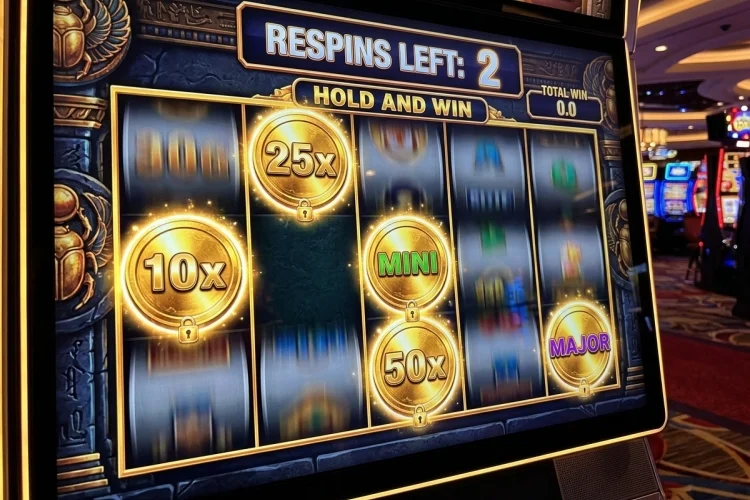
Few slot bonuses are as easy to recognize as a grid slowly filling with glowing coins. Several symbols land, everything else disappears, and a counter starts offering a limited number of respins. Each new coin can keep the sequence alive.
But What Is a Hold and Win Feature? At its core, it is a collection-based respin bonus. Special symbols become locked while empty positions continue spinning.
Modern versions can then add jackpot prizes, collectors, grid upgrades, multipliers, and progress meters. Understanding those variations helps explain why two Hold and Win slots can feel completely different.
The Basic Hold and Win Loop Is Simple
Most versions can be reduced to four steps.
First, the required Coin, Cash, or Bonus symbols appear.
Second, those symbols become locked on the grid.
Third, the remaining spaces receive respins.
Finally, newly landed qualifying symbols stay locked and usually reset or extend the respin counter.
BGaming describes three starting respins as common in the format, although individual games can use different numbers.
The bonus ends when the available respins expire or another ending condition – such as filling the complete grid – is reached.
That simplicity is one reason the mechanic has become so widely used.
Why Three Respins Appear So Often
Three respins create an easy countdown for the player to follow.
Suppose a feature begins at three.
An empty respin drops the counter to two. Another empty result leaves one.
But if a new qualifying symbol appears, many games reset the number back to three.
Joker’s Jewels Hold & Spin follows this basic pattern. Three or more Money symbols trigger the feature, and each additional Money symbol can keep the respin sequence going while collected symbols remain fixed.
Floating Dragon Megaways Hold & Spin also begins its Hold and Spin sequence with three respins, with each new Coin resetting the count.
Three is therefore common, but it is not universal.
Hot to Burn Hold and Spin begins with four.
Hold and Win Is Really a Collection Mechanic
Although the feature is usually described through respins, collecting symbols is the real engine underneath it.
Every newly landed Coin increases the number of locked positions.
That can do several things at once.
The symbol may add an individual prize value, move the grid closer to a full-screen reward, trigger a jackpot label, increase a progress meter, or activate another modifier.
BGaming’s Gold Rush with Johnny Cash uses six or more Coin symbols to activate its Hold and Win bonus. Those triggering Coins remain locked while other positions continue with respins.
This collection logic makes the mechanic visually intuitive.
Instead of calculating complicated payline combinations, players can simply see the bonus grid filling over time.
Filling the Grid Can Unlock a Special Reward
The empty positions are not just visual space.
In many games, filling every position creates an additional prize.
Joker’s Jewels Hold & Spin awards 10,000x when the entire feature grid is filled with Money symbols.
Hot to Burn Hold and Spin uses another approach. Filling all available positions activates its Big Money Wheel, where additional prize values can be awarded.
This changes how the bonus builds tension.
A single empty position near the end can represent the difference between receiving only accumulated Coin values and activating an entirely seperate full-grid reward.
However, a nearly full grid does not mean the missing symbol is guaranteed to appear.
Each new event still follows the game’s underlying random system.
Jackpots Can Be Attached to Individual Symbols
Hold and Win bonuses frequently use fixed jackpot labels.
One symbol may represent a Mini prize, another a Minor, while higher tiers can include Major or Grand jackpots.
BGaming identifies this tiered structure as a common extension of the standard mechanic.
Some newer games also connect jackpots to progress outside the immediate respin sequence.
Grand Buffalo Hold and Win uses Scatter collection to progress toward a Mega Jackpot opportunity, while its Coin Respin feature also incorporates Mini and Major jackpot possibilities.
This makes jackpot rules worth reading carefully.
A jackpot shown on screen may be fixed, progressive, randomly triggered, tied to a specific symbol, or dependent on filling a collection meter.
The visual label alone does not explain the mechanicss.
Multipliers Add Another Layer
A Coin does not always contain only a fixed value.
Modern variants can multiply individual symbols or the entire collected bonus.
BGaming’s Ultras uses a progress bar during its Hold and Win bonus. Collecting 15 Bonus symbols multiplies relevant wins by 2x, while reaching 20 applies a 3x multiplier.
Golden Avalon Hold and Win introduces even more elaborate effects.
BGaming describes Arthur’s Sword as splitting symbols, while Merlin’s Staff can multiply them. The game contains four Hold and Win-related bonus modes built around different combinations of these effects.
These systems demonstrate why newer Hold and Win games can be considerably more complex than the original coin-locking concept.
The best way to understand them is to learn the base mechanic first.
Some Games Expand the Feature Beyond a Fixed Grid
Another variation involves changing the playing area.
Some Hold and Win games unlock extra rows, positions, or sections as the feature progresses. Others start with a larger grid but restrict certain cells until particular conditions are reached.
BGaming notes that expanding reels and grid upgrades are among the variations now commonly layered onto Hold and Win gameplay.
These designs change the importance of collected symbols.
A new Coin might not only add its displayed value; it could also unlock more room for future Coins.
This creates progression within the bonus itself.
The feature therefore becomes less like a single respin round and more like a short evolving mini-game.
Hold and Win and Hold and Spin Are Usually Related Terms
Players sometimes wonder whether Hold and Win and Hold and Spin describe completely different mechanics.
Usually they refer to closely related formats.
BGaming notes that Hold & Win, Hold & Spin, Hold & Link, and Stick N Win are industry names used around the same broad concept of locked symbols plus respins.
The branding depends on the provider.
Pragmatic Play frequently uses “Hold and Spin,” while BGaming releases often use “Hold and Win.”
The actual rules matter more than the label.
One Hold and Spin title could start with four respins, while a Hold and Win game might begin with three and include jackpots.
Always treat the paytable as the final source of information.
How Is It Different From a Traditional Respin?
A normal respin can simply spin one or more reels again.
Hold and Win creates a more structured bonus system around that idea.
Qualifying symbols persist, a limited counter tracks remaining attempts, and the goal becomes accumulating additional symbols before the sequence ends.
The feature may also separate itself visually from the base game.
Only Coins and blank positions might appear, making the respin round feel like a dedicated bonus grid rather than a repeat of the standard reels.
That distinction is why Hold and Win became recognizable enough to function almost like its own slot category.
The respins are important, but the holding and collecting are what define the feature.
Volatility Can Be Higher Around the Bonus
Hold and Win games often place a meaningful portion of their prize potential inside the bonus.
BGaming notes that many titles using the mechanic sit in the medium-to-high or high-volatility range because larger outcomes can depend heavily on respin chains, multipliers, locked values, and jackpot combinations.
That does not mean every Hold and Win game has identical volatility.
BGaming’s 2026 Ultras, for example, is listed as Medium-Low volatility despite using a progressive Hold and Win feature, while Grand Buffalo Hold and Win is listed as High volatility.
This is a good reminder not to infer mathematical characteristics from the mechanic alone.
Read the individual game’s RTP and volatility information.
Use Demo Play to Understand the Sequence
Hold and Win is particularly well suited to demo learning.
The feature is visual enough that a few bonus rounds can explain the rules more effectively than a long description.
Watch what triggers the feature, how many respins are initially awarded, what resets the counter, and what happens when the grid fills.
Also note whether Coin values remain fixed or can be multiplied.
BGaming specifically points to demo play as a way to understand Hold and Win behavior before using real money.
A demo cannot predict what future random rounds will produce, but it can make the rules much more accesible.
What Is a Hold and Win Feature? It is a respin-based bonus where qualifying symbols stay locked while new symbols can extend the round and build the final prize.
Modern versions may add jackpots, multipliers, progress meters, or expanding grids.
Check the individual paytable and try the demo where available so you understand the exact rules rather than assuming every Hold and Win game works identically.